
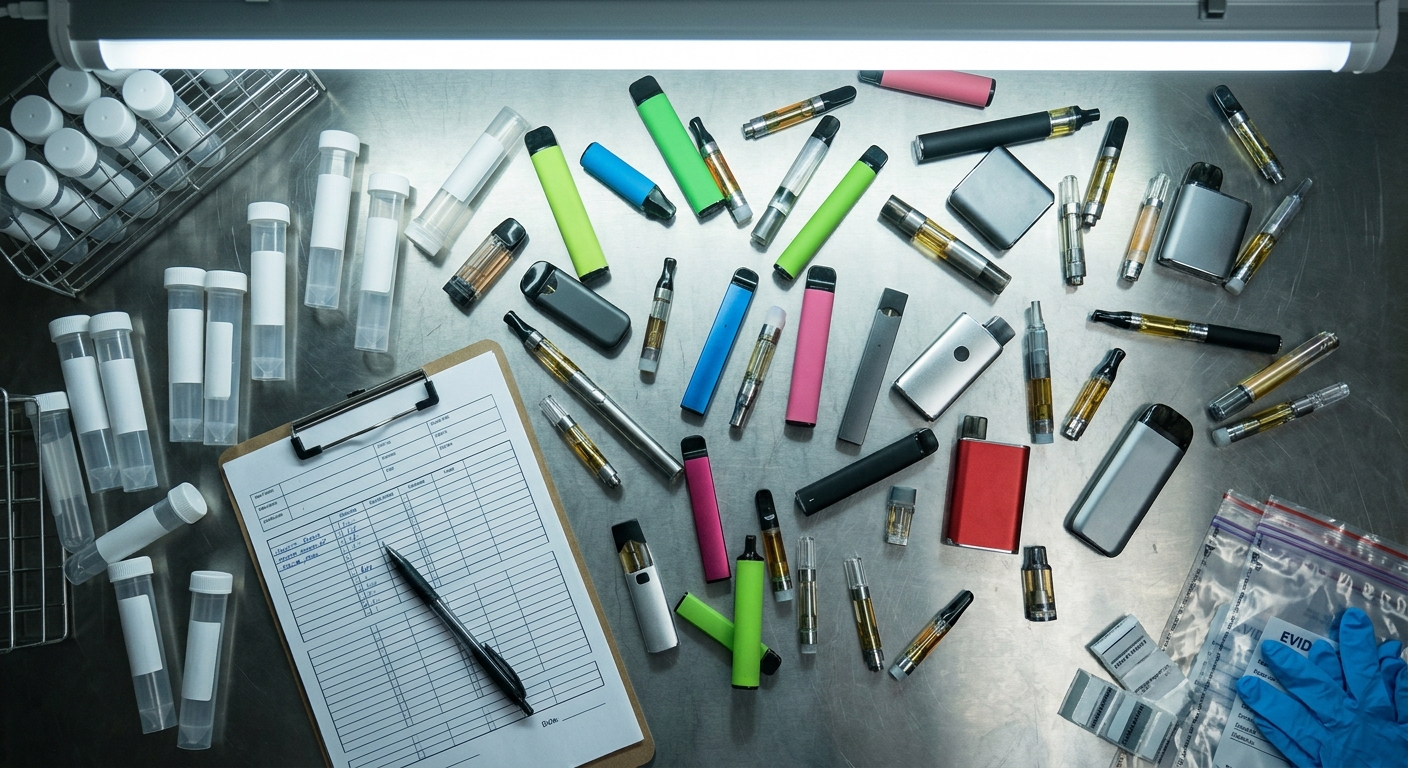
We pulled every cannabis vape tested this year by the UK’s only public drug-checking service. A third contained cannabis. A third contained spice. The rest contained nicotine, nothing at all, or in one memorable case, cocaine and ketamine.
Twenty-odd years ago the worst thing you’d find in a British cannabis product was soap bar: hash cut with henna, pine resin and whatever else the importer had lying around. It was rubbish, but it was rubbish that got you mildly stoned. We used to complain about it. We didn’t know we were born.
The modern equivalent is the THC vape, and the modern equivalent of henna is a pair of chemicals called 5F-MDMB-PINACA and MDMB-4en-PINACA: synthetic cannabinoids, the family sold on the street as spice, and linked by the NHS to seizures, cardiac problems and psychotic episodes.
It is being sold in cartridges labelled “THC”, to people who think they’re buying weed, and increasingly to children who think they’re buying strawberry ice vapes.
I wanted to know how often. So rather than rely on the annual headline number, I downloaded every sample result published by WEDINOS — the Welsh Emerging Drugs and Identification of Novel Substances project, run by Public Health Wales, and the only free, anonymous, nationwide drug-checking service in the UK — and pulled out every vape that was sent in as THC, CBD or cannabis.
Anyone in the UK can post them a sample; they run it through a lab and publish what they find, by postcode. It’s the closest thing Britain has to a window into the illicit market, and almost nobody outside public health looks through it.
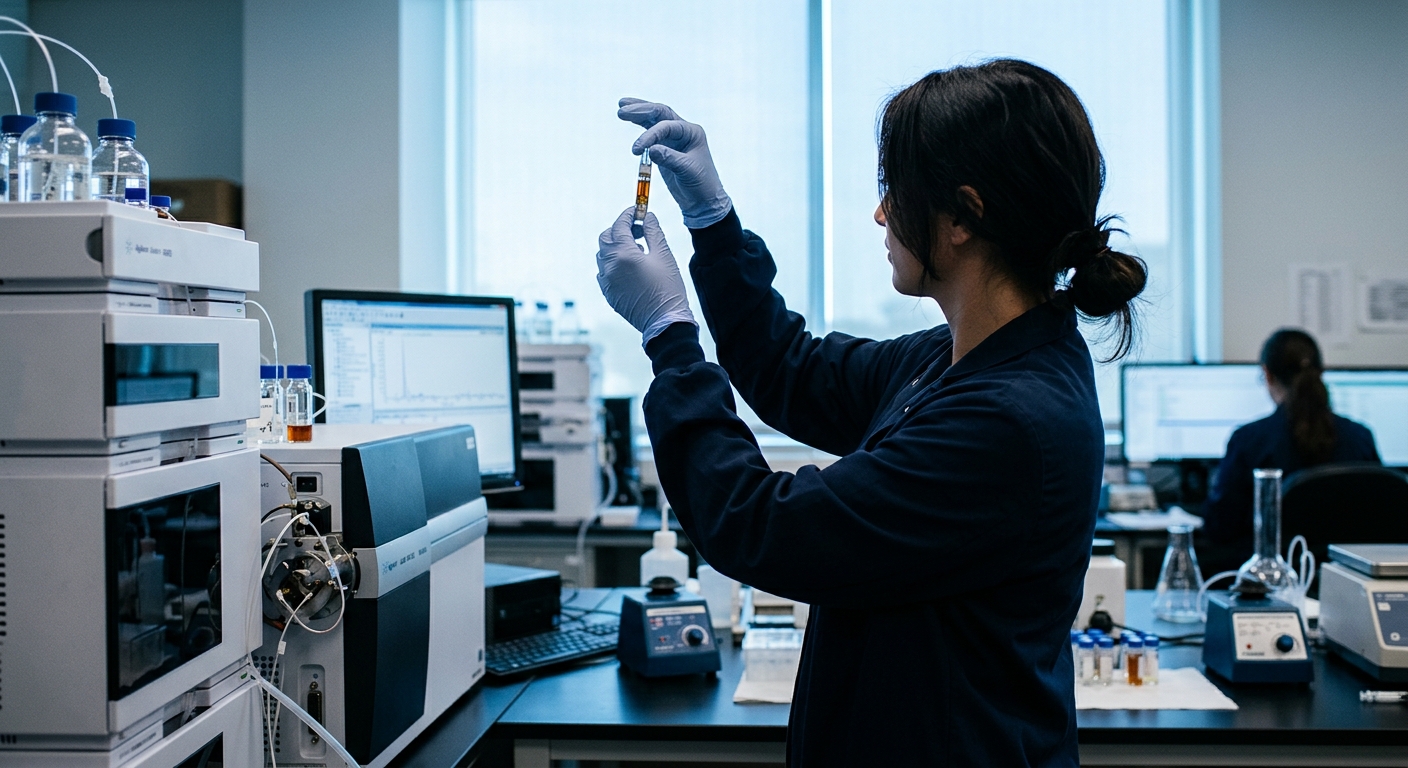
Here’s what was in the 77 cannabis vapes they tested between March and August this year. Each dot is one cartridge.
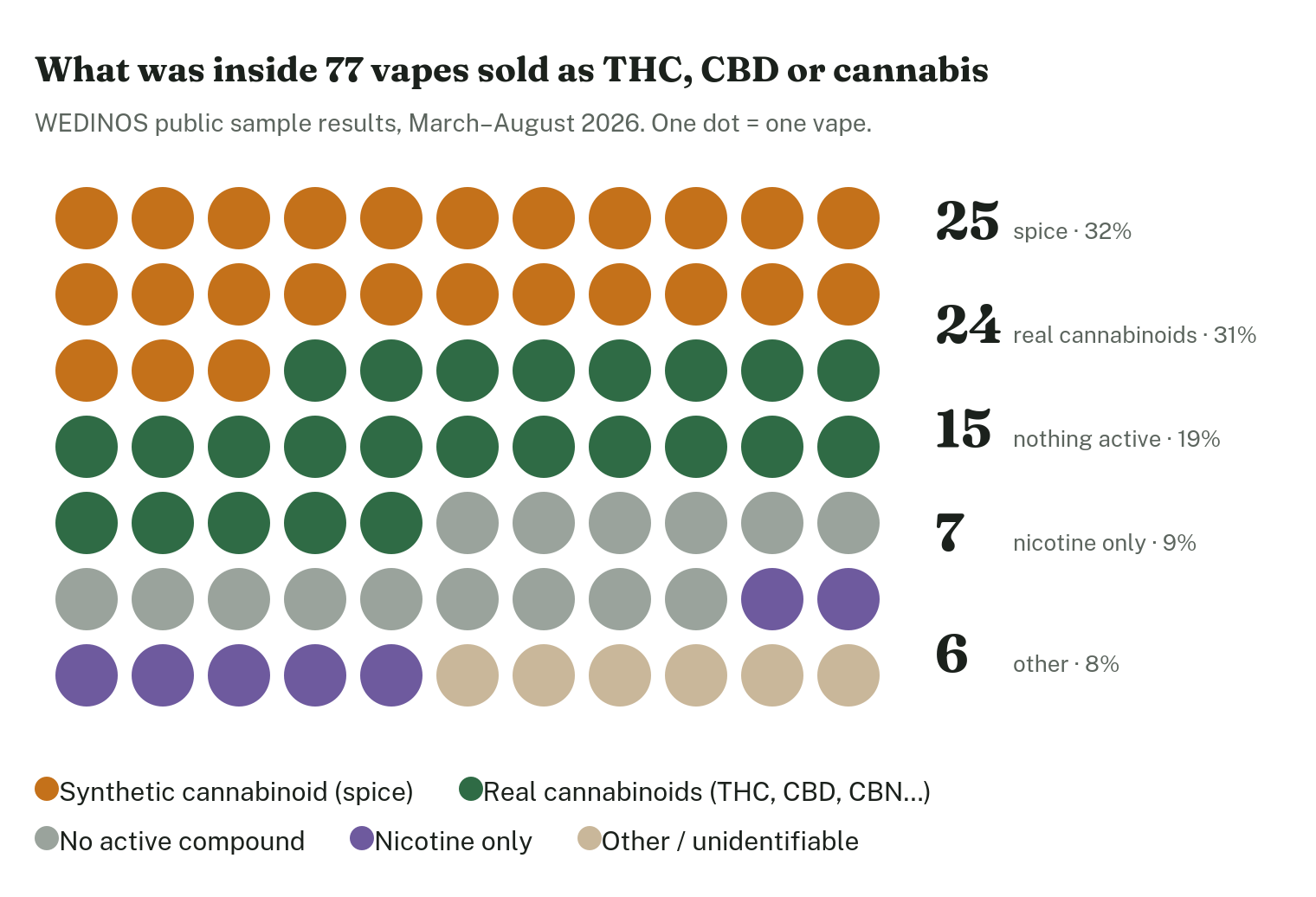
So: 24 out of 77 contained what the buyer paid for.
Twenty-five contained a synthetic cannabinoid, and of those, 23 contained no cannabis whatsoever.
Fifteen contained nothing active at all, including a cartridge whose packaging promised “5000mg THC vape liquid” and delivered precisely no milligrams of anything.
Seven were plain nicotine e-liquid in a THC box. And one, sent in as a THC vape, came back as cocaine and ketamine.
Buy a THC vape on the street in Britain today and you have about a one-in-three chance of getting cannabis.
Now, the honest caveat, because the numbers only mean something if you know where they come from.
WEDINOS samples are self-selected: people tend to send in things they’re already suspicious of, so this is not a random survey of every cart in the country, and 77 samples is a small set — treat the percentages as give-or-take ten points.
But the direction of travel isn’t in doubt.
WEDINOS’s own annual report for 2024/25 put synthetic cannabinoids in almost 40% of vapes sold as cannabis; the 2025/26 report, published last week, put it at 43%.
A peer-reviewed analysis of 1,635 WEDINOS cannabis samples up to late 2024 found that only about 36% of vape products contained any natural cannabinoid at all. My six months of data sit squarely inside that picture.
This is a vape problem, not a cannabis problem
The most useful thing in the data is what it says about everything other than vapes.
WEDINOS also tested 68 samples of actual plant matter and hash over the same period. Seventy-nine percent contained real cannabinoids. Two contained a trace of a synthetic. Not a single one was spice masquerading as weed.
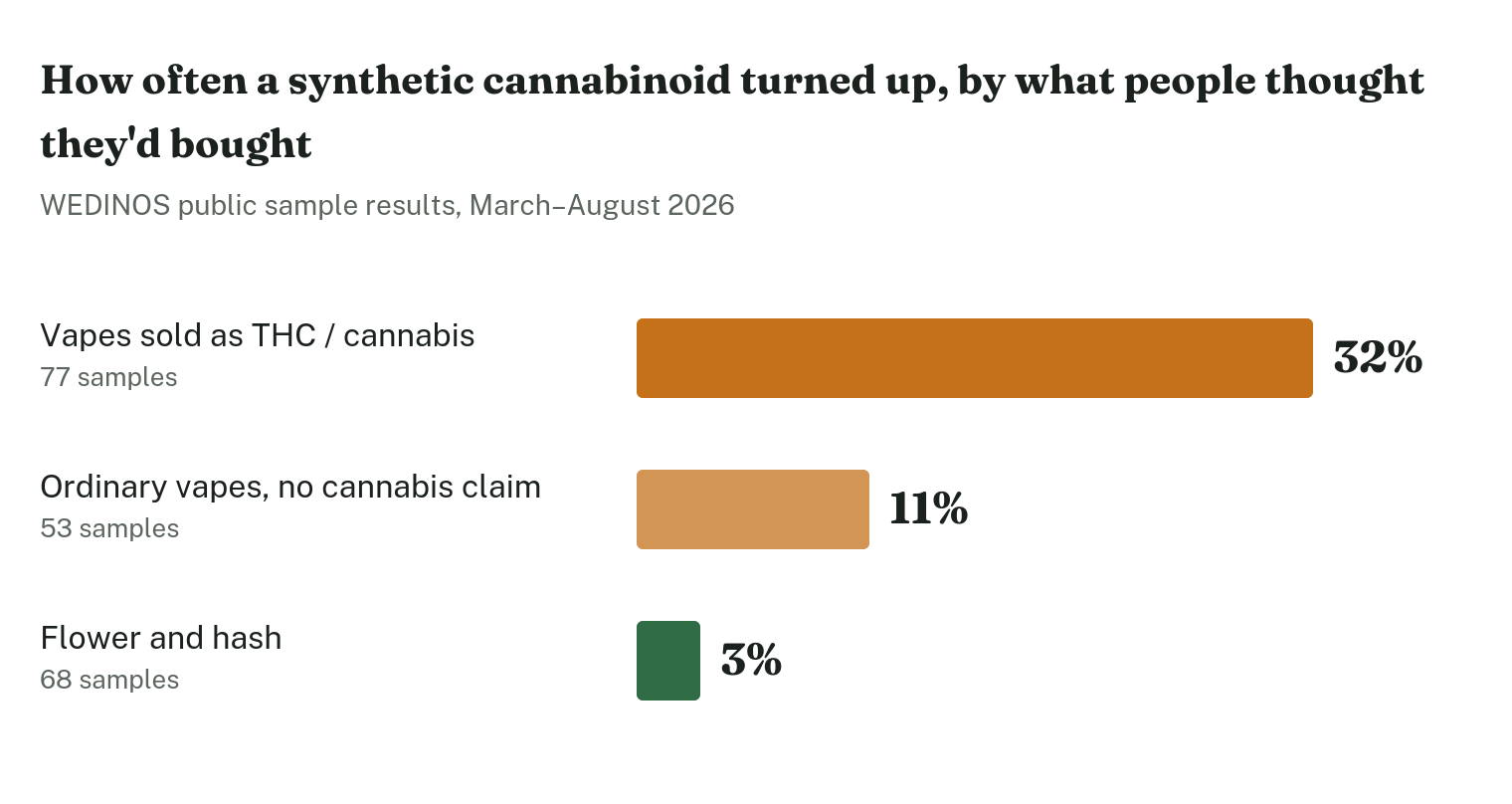
That middle bar is the one that should worry parents, and it’s the one nobody is talking about. Fifty-three vapes were sent in with no cannabis claim at all — people who thought they’d bought plain e-liquid.
Six of them contained a synthetic cannabinoid. Two came from the same postcode district on Tyneside.
Somebody, somewhere, is selling spice in cartridges that don’t even pretend to be cannabis.
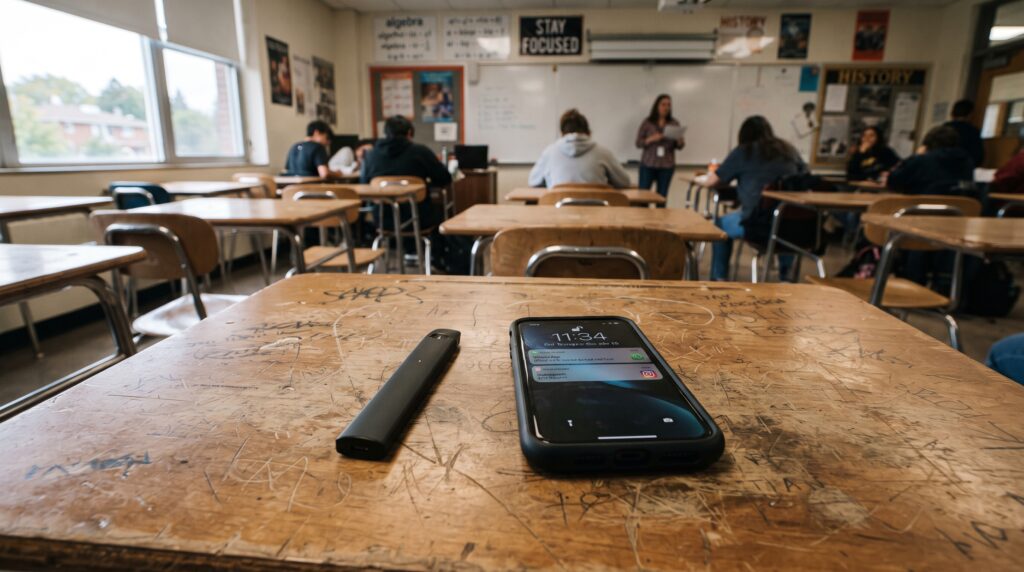
If you smoke flower or hash, the lab says your main risk is that you’ve overpaid.
If you use carts, your main risk is that you don’t know what you’re inhaling. Every long-time smoker I know has quietly reached the same conclusion; it’s nice to have the chemistry confirm it.
It’s basically two chemicals
The lab named the synthetic in every spice-positive vape, and it was nearly always one of two close relatives. 5F-MDMB-PINACA (the lab often writes it as 5F-ADB) turned up in fourteen of the 25; MDMB-4en-PINACA in twelve; a third cousin, MDMB-INACA, in four.
Several carts contained more than one. These are third- and fourth-generation synthetic cannabinoids: full agonists at the CB1 receptor where THC is only a partial one, which in plain English means they push the same button harder than cannabis is physically capable of pushing it.
Effects that are unheard of with real cannabis — seizures, collapse, acute psychosis, dependence with a nasty withdrawal — are routine with these.
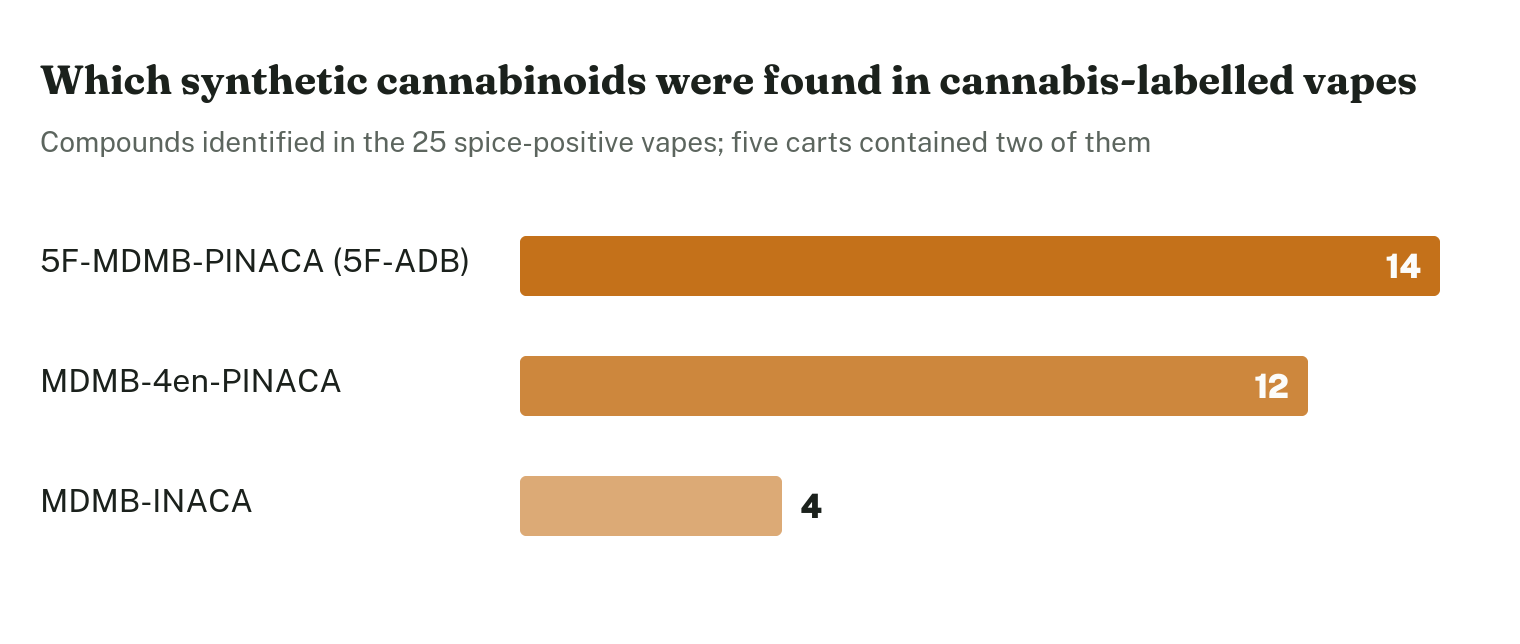
Compounds identified in the 25 spice-positive vapes.
All three are controlled as Class B drugs in the UK under the generic synthetic cannabinoid definition. None are detectable by smell, taste, colour, or any test kit you can buy.
Why these? Because they’re cheap, potent enough that a cartridge needs a fraction of a gram, dissolve in the same propylene glycol base as nicotine juice, and — this is the important bit — a manufacturer in a Chinese lab doesn’t need a single cannabis plant to make them.
A cart full of real distillate requires someone to grow, extract and ship an agricultural product across borders.
A cart full of 5F-ADB requires a courier and a label printer.
Given those economics, the surprising number in the chart isn’t the 32% that were spice. It’s the 31% that were real.
It isn’t getting better
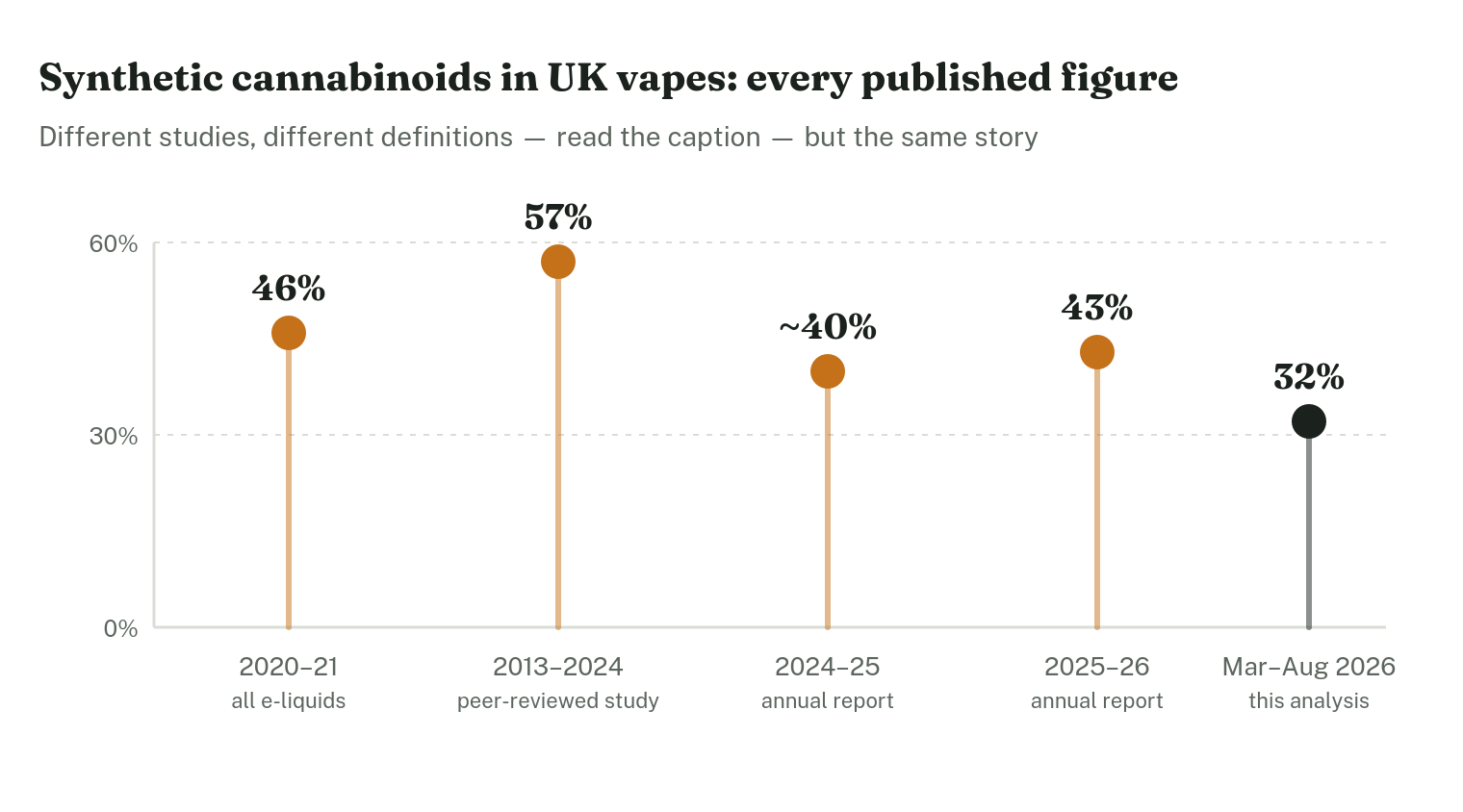
Across WEDINOS submissions, synthetic cannabinoids have appeared in a substantial minority of vapes throughout the last decade. A 2024 Addiction study found 46% of all e-liquids submitted in 2020–21 contained a synthetic cannabinoid;
Public Health Wales annual reports show ~40% of cannabis-labelled vapes in 2024–25 and 43% in 2025–26.
Our own Mar–Aug 2026 analysis (77 samples, same definition) found 32% — nominally lower, though within sampling uncertainty of prior years.
Separately, a 2025 Journal of Psychoactive Drugs study covering 2013–2024 found 57% of cannabis-labelled vapes contained any psychoactive adulterant — a broader measure that includes non-synthetic-cannabinoid adulterants.
The figures aren’t perfectly comparable — the peer-reviewed study counted any adulterant, the annual reports count synthetics specifically, and my six months are a small sample within the 2025/26 year — but you don’t need them to be.
Since the first alarm was raised in 2020, roughly two in every five cannabis vapes checked in Britain have contained spice, and nothing has moved that number in the right direction. Not a single enforcement operation, not a single school assembly, not a single headline.
Why prohibition makes this worse for children, not better
I spent the early part of my working life as a Metropolitan Police officer, and I’ll say what most of my former colleagues will say to you in private: nothing we did to the cannabis supply chain ever made the product safer. That was never the goal. The goal was to disrupt it, and disruption has a side effect that the people cheering it on rarely think about.
When you make a market illegal, you don’t remove the market. You remove the labels.
Think about what is actually protecting a fifteen-year-old (like my daughter) from the products in the first chart. It is not the law.
The law is precisely what guarantees that the cart she buys from a Snapchat account has no ingredients list, no batch number, no age check, no lab certificate, no recall mechanism, and no one to complain to when she ends up in A&E.
The dealer doesn’t card her. The manufacturer in Shenzhen doesn’t know or care what’s in it. The only quality control in the entire chain is a free postal service in Cardiff that most people have never heard of.
In the legal cannabis markets that now exist across Canada and most of the United States, the specific product in this article does not exist. Not because those places have fewer criminals, but because a licensed dispensary sells vapes with a lab certificate on the packaging, batch-tested for cannabinoid content and contaminants, to adults who show ID.
Spice carts in those markets are an illicit-market product, sold to people who can’t or won’t use the legal one.
That’s what regulation does. It doesn’t stop everyone. It gives most people somewhere safer to go, and it moves children from being the market’s most profitable customers to being its hardest ones to reach.
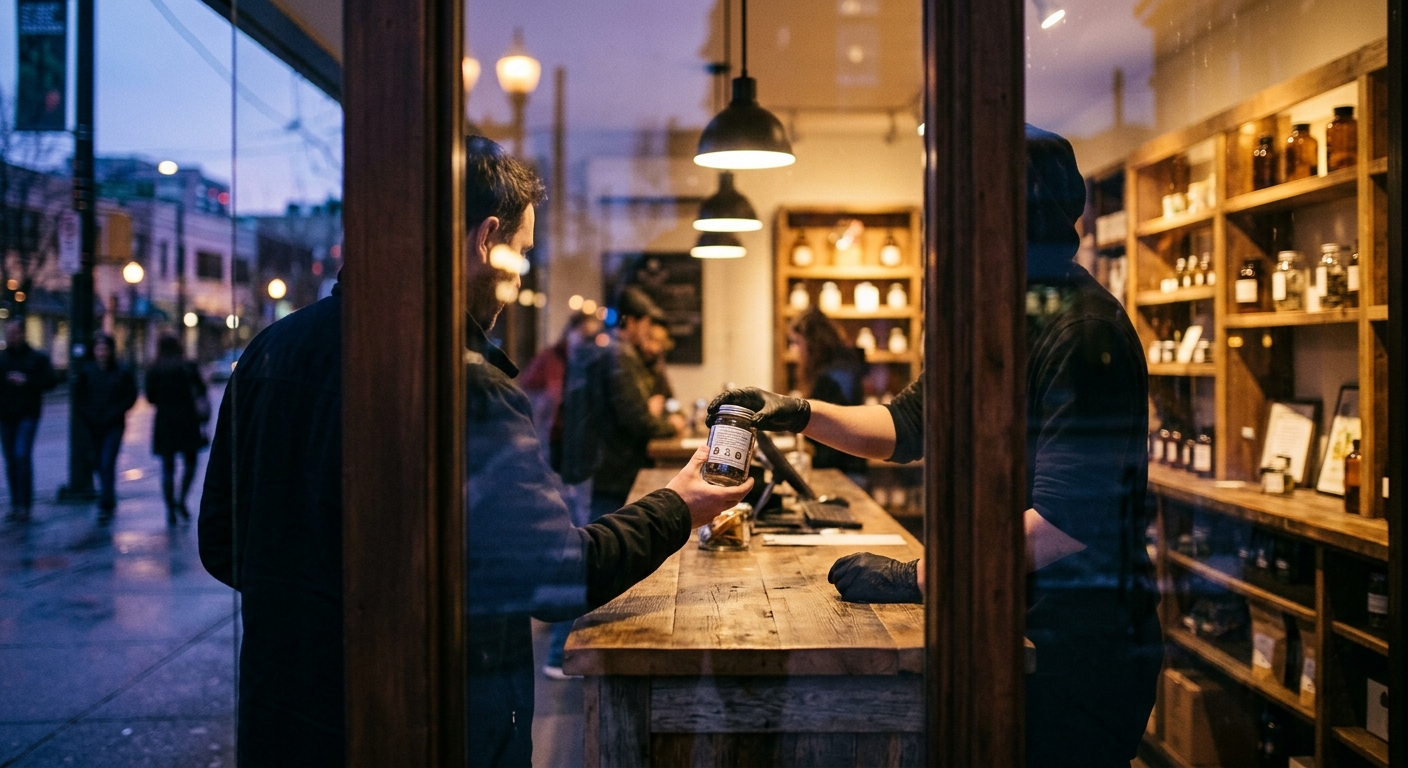
Prohibition’s defenders will say the answer is simply to stop kids buying vapes at all, and I’d love that too. But the disposable-vape ban, the school assemblies and the confiscations have all happened, and the numbers above are what the market looks like after them.
Teenagers are going to buy vapes. The only question a serious adult can ask is whether the vape they buy came from a supply chain with any accountability in it whatsoever. Right now, in Britain, the answer for every street THC vape is no, and the chart is the consequence.
What we have instead is the worst of both worlds: a product that’s illegal enough to be unregulated, and available enough that a child can have one delivered in twenty minutes. The spice in that cartridge isn’t a failure of the law. It’s the law working exactly as designed.
What you can actually do
If you or someone you know uses carts, the practical advice is short, because there’s no trick to it. You cannot tell by looking, smelling, tasting or vaping whether a cartridge is distillate or spice; the two are indistinguishable right up until the point where one of them puts you on the floor.
Branded packaging is no guarantee either: in this dataset every spice cart was labelled either “THC” or nothing at all, while the handful in American-style branded boxes — Packwoods, Jungle Boys, Blinkers — were either real or completely empty. Seven branded carts is far too few to call brands safe, and counterfeit packaging is a cottage industry. There is no test kit on sale that detects synthetic cannabinoids reliably.
What does work is WEDINOS itself. Anyone in the UK can post them a sample, free and anonymously, and get a result back online within a couple of weeks. If you use vapes regularly and can’t or won’t stop, sending a sample from each new batch is the single most effective harm-reduction step available to you.

And if you’re a parent who’s found a cartridge in a bedroom, don’t guess — send it. Samples in this dataset arrive with notes like “liquid was concealed in bedroom”; the service exists for exactly that.
If you can choose your form of cannabis, the data has an opinion: flower and hash contained real cannabinoids 79% of the time and never once came back as spice instead of cannabis.
Twenty years ago I’d have laughed at the idea of soap bar being the safe option. Here we are.
And if you’re a journalist, a councillor, or an MP looking for the Snapchat generation’s drugs story: it isn’t cannabis. It never really was.
It’s a pair of chemicals called 5F-MDMB-PINACA and MDMB-4en-PINACA, they’re in one in three THC carts and one in ten “ordinary” ones, and every single one of them is there because we’ve built a market in which nobody is allowed to write the ingredients on the box.
Method and data
- All results are from the public sample database at wedinos.wales, published by Public Health Wales. WEDINOS is the UK’s only nationwide, free, anonymous drug-checking service; the outcomes of every analysis are published openly. I retrieved every result listed on the site as of 2 September 2026 (3,338 records, of which 2,588 were analysed; the rest were rejected submissions).
- “Cannabis vapes” are the 77 analysed samples where the submitter’s stated purchase intent or the package label mentioned THC, CBD, cannabis or a cannabis product, and the sample was a liquid, cartridge, pen or e-liquid. Samples submitted as “spice” were excluded. “Ordinary vapes” are the 53 liquid/vape samples with no cannabis or spice claim. “Flower and hash” are the 68 cannabis-claimed samples recorded as plant matter or solid.
- A sample counts as spice-positive if any synthetic cannabinoid receptor agonist appears in the lab’s major or minor components. The lab reports 5F-MDMB-PINACA under its older name 5F-ADB; the two are the same compound and are counted together.
- WEDINOS results are qualitative — they say what was present, not how much. Samples are self-selected and skew towards things people were already suspicious of. Treat the percentages as an upper-bound signal from a small sample (±10 points at n=77), not a national prevalence estimate. The direction is corroborated by two annual reports and a peer-reviewed study on the same dataset.
- The full classified dataset is available on request. I’m grateful to WEDINOS for publishing this data at all; if you use their service, consider telling your MP it deserves funding for every nation in the UK.
