
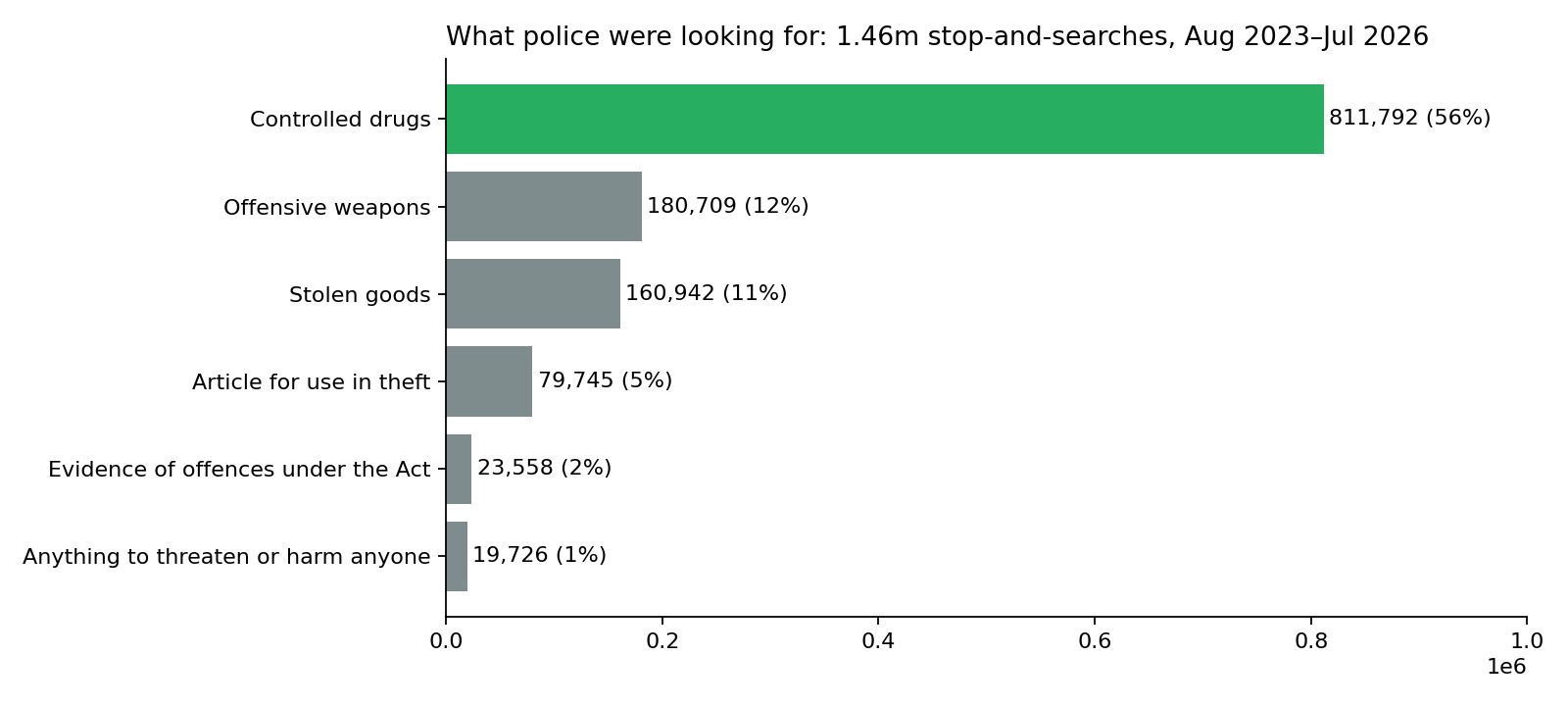
Every stop-and-search in England and Wales is published, one row at a time. I pulled three years of them — 1.46 million searches — and asked one question: what are the police actually looking for, and do they find it?
The answer to the first half is drugs. Not knives, not guns, not stolen goods. Drugs are the reason for 56% of every stop-and-search carried out in this country. Weapons — the thing every Home Secretary reaches for when stop-and-search is questioned — are 12%.
The answer to the second half is no. Of 811,792 drug searches between August 2023 and July 2026, 550,166 ended in “no further action.” That’s 67.8%. Nothing found, nobody charged, nobody even given a warning. Just an innocent person stood against a wall with their pockets turned out, and an officer walking away.
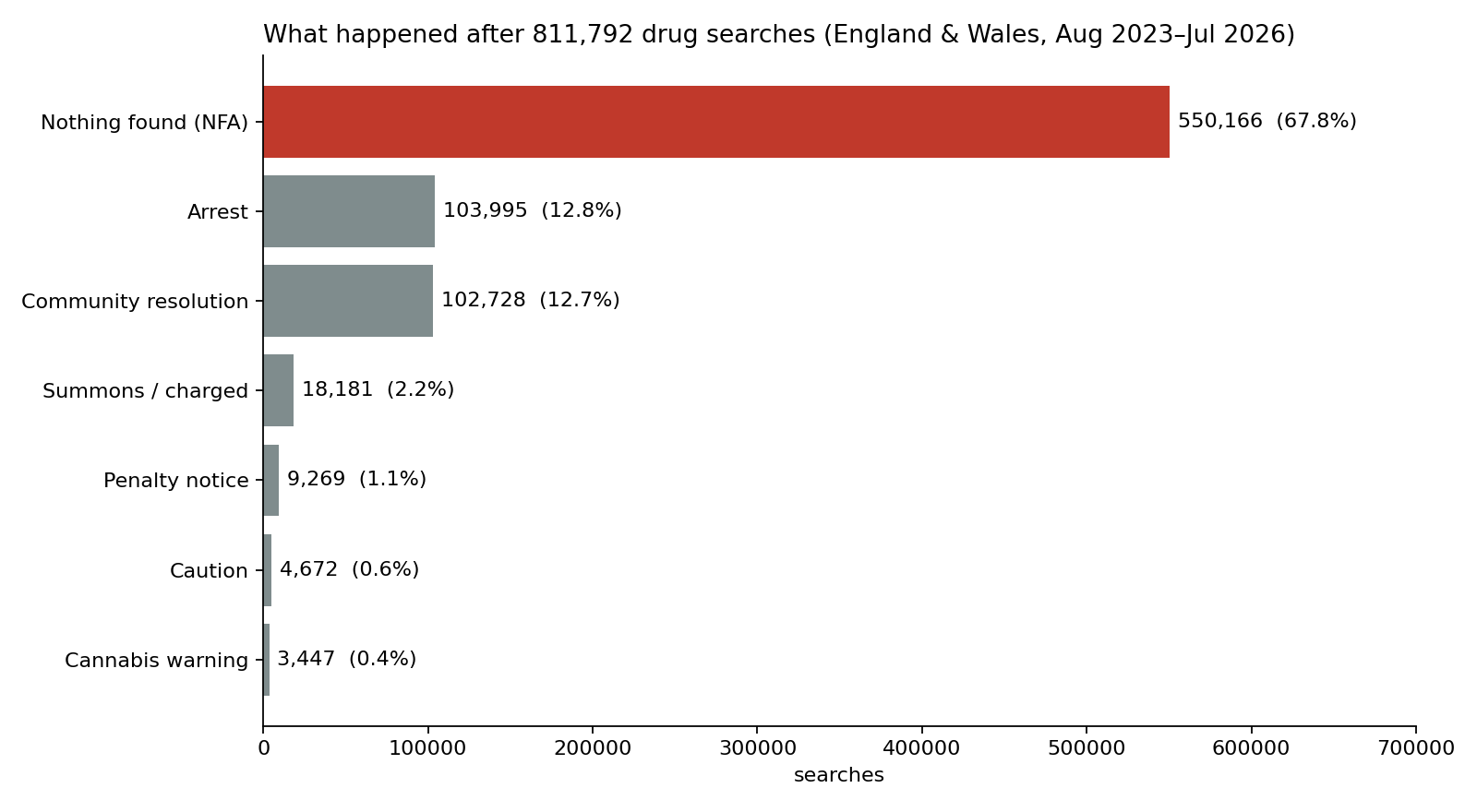
Over the last twelve months that’s 270,000 drug searches, which is one every two minutes, day and night, all year. Roughly five hundred times a day, someone in England or Wales is searched for drugs and the search finds nothing.
What the search is for
The data records the object of search as “controlled drugs,” not “cannabis,” so let me be straight about the limit of what it can prove. It can’t tell me what substance the officer had in mind.
But the Home Office’s own statistics and the police inspectorate have both said, repeatedly, that the large majority of drug searches are for cannabis possession — and the one drug-specific outcome in the data, the “khat or cannabis warning,” is the only substance that gets its own box. Nobody has a cocaine warning.
So read “drug search” as “mostly weed” throughout, and if a chief constable wants to tell me it’s actually mostly heroin, my inbox is open.
The postcode lottery
Here is where it stops being a national story and becomes forty separate ones. Take the last twelve months, divide each force’s drug searches by the people it polices, and this is what you get.
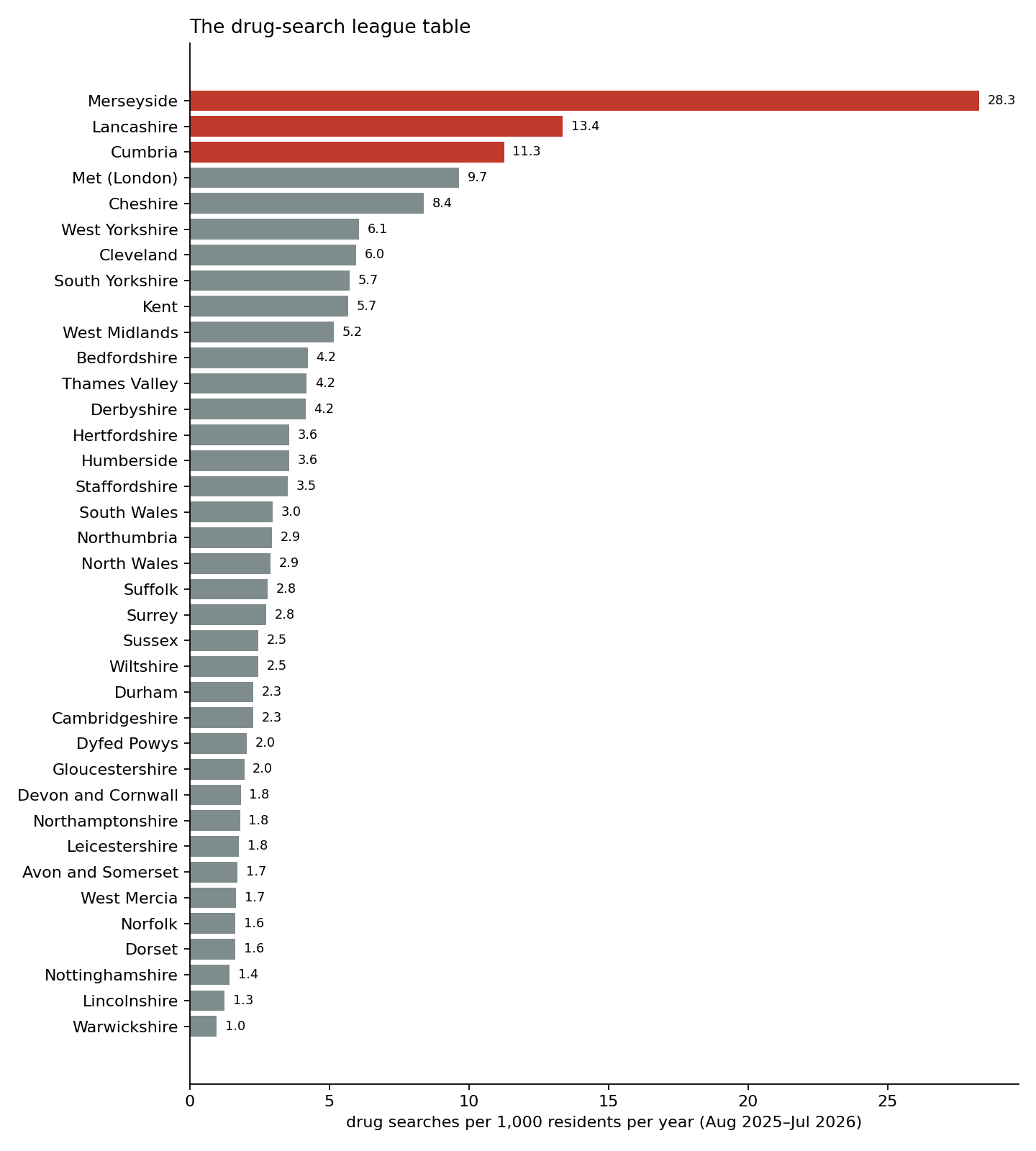
Merseyside searches its residents for drugs at 28 per 1,000 people per year. That’s three times the Met, and 28 times Warwickshire.
Where Britain gets searched for drugs
811,792 stop-and-searches for controlled drugs, England & Wales, Aug 2023–Jul 2026. Circle size = number of searches; colour = share that found nothing.under 55%
55–70%
70–85%
over 85%
Source: data.police.uk (OGL v3). Locations are anonymised to the nearest public point. GMP, Essex, Gwent and Hampshire not included.
Cross the border into Cheshire and the rate drops by two-thirds. Lancashire and Cumbria are the only other forces above ten.
Everyone else is in single figures, and most of the country is below four.
Nothing about the population explains this. Liverpool does not have twenty-eight times the cannabis of Leamington Spa. What it has is a force that has decided, as a matter of policy, that this is how it spends its officers’ time.
The “postcode lottery” is a cliché, but there’s no other phrase for it: whether you get searched for weed this year depends far more on where you live than on whether you’ve got any.
And the forces that search hardest find least.
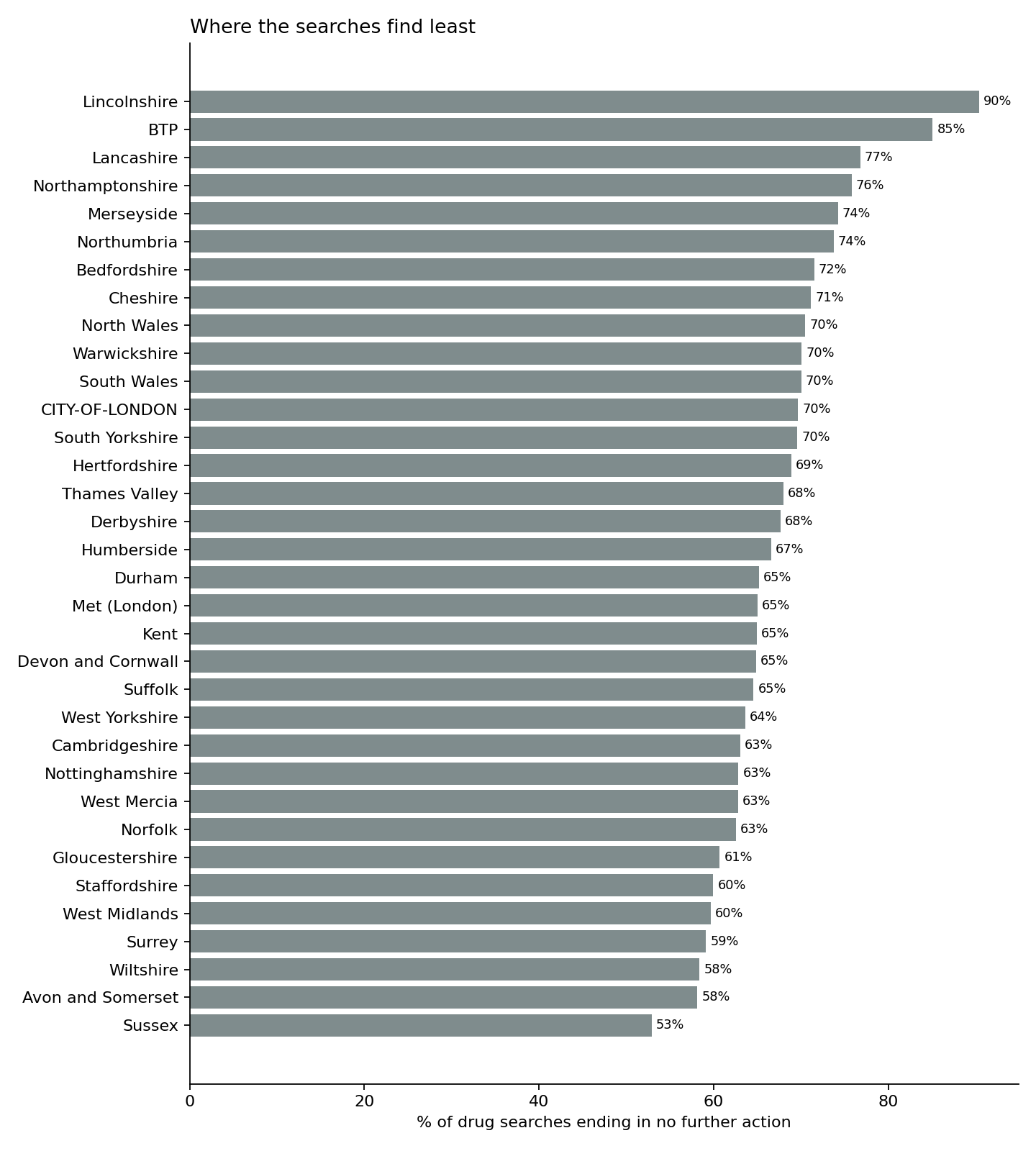
Lincolnshire’s drug searches come up empty 90% of the time. Lancashire’s, 77%. Merseyside’s, 74%. At the other end, Sussex finds something (or at least does something) in almost half its searches — and searches at a tenth of Merseyside’s rate. If you search everyone, you find less per search. This is not a difficult idea.
When it happens
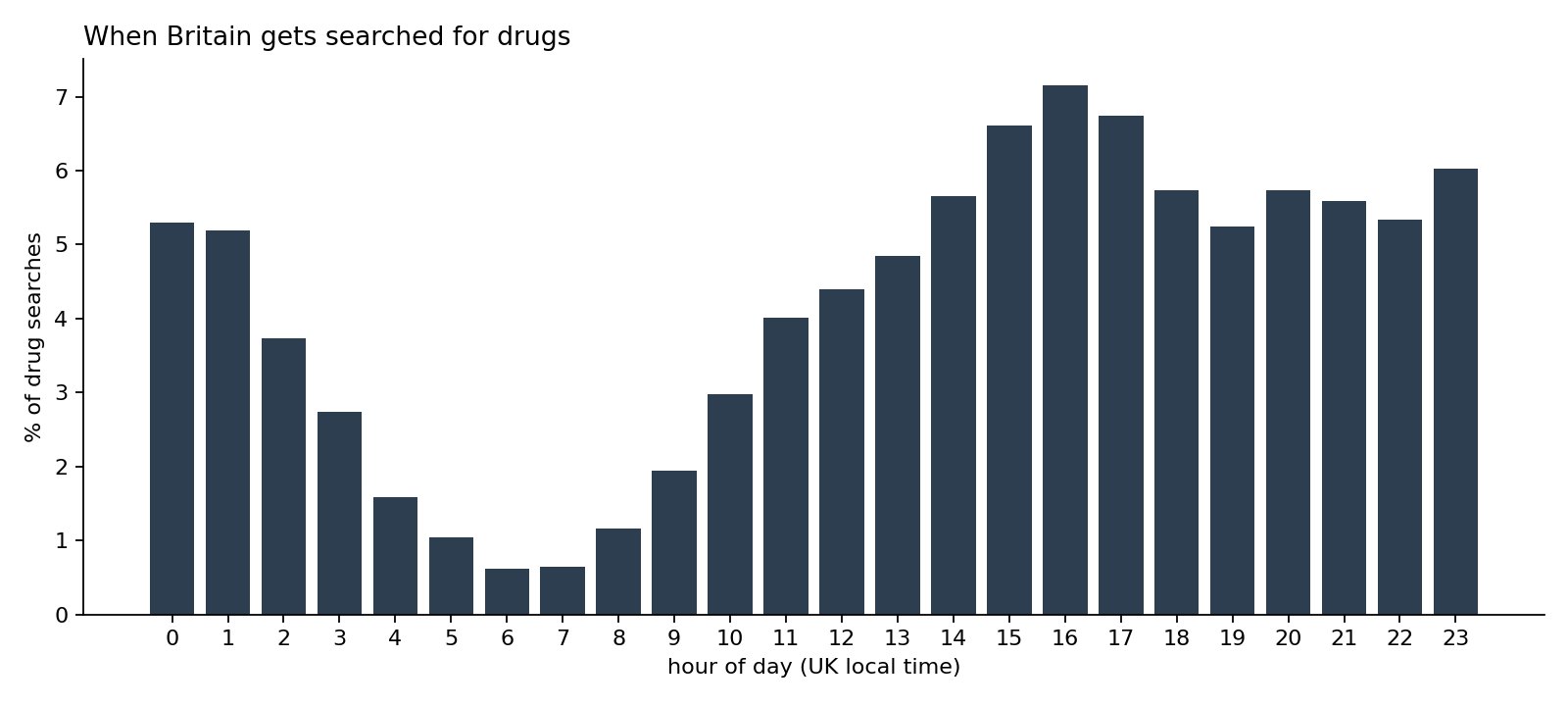
Searches peak at four in the afternoon, when the schools come out, and then there’s a second long tail after the pubs close: 28% of all drug searches happen between 10pm and 4am.
Friday is the busiest day, Sunday the quietest. Cannabis consumption, according to Europe’s wastewater monitoring, is one of the few drugs spread evenly across the week — it’s the stimulants that spike at weekends. The searches follow the nightlife, not the drug.
The children
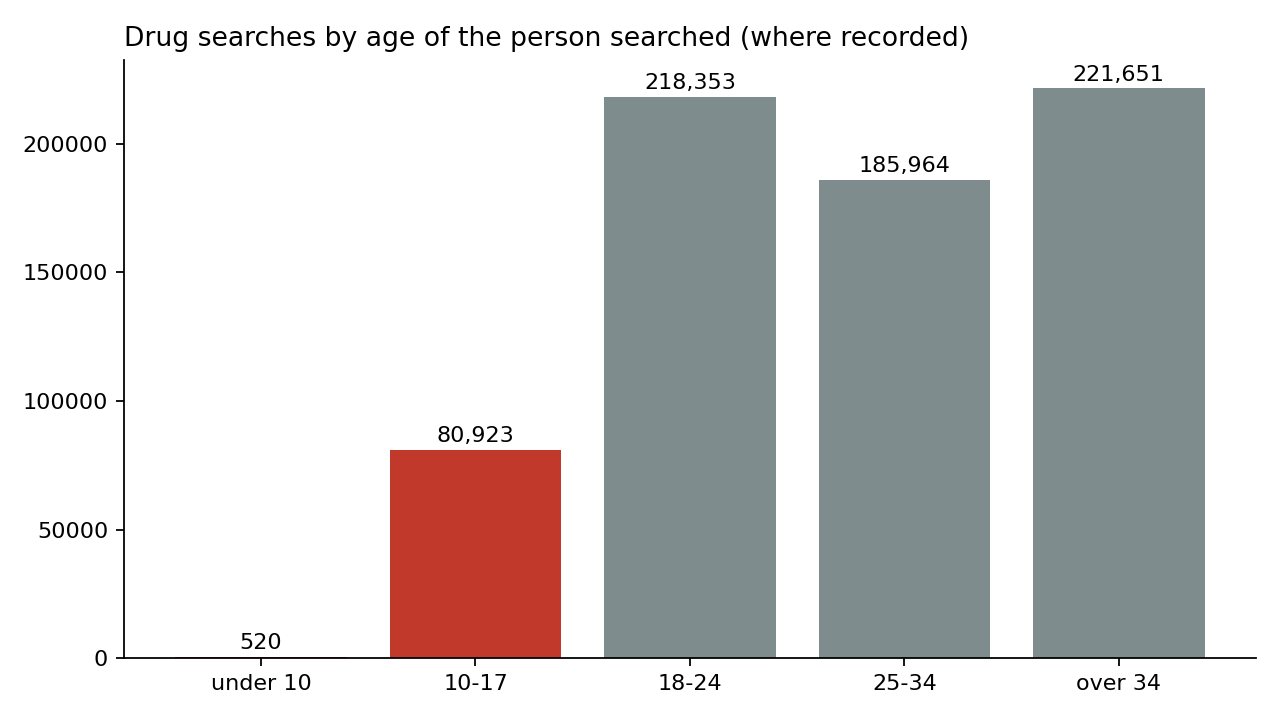
80,923 of these searches were of children aged 10 to 17. Eleven percent of the total. A further 520 were recorded as under ten years old — 297 of those by the Met.
Children fare worse than adults: 76% of drug searches on 10–17 year olds found nothing, against 68% for adults. Kids get searched more speculatively, and they’re less likely to be carrying.
Then there’s the search that involves removing more than outer clothing. 19,728 drug searches in three years went that far. 1,153 of them were of children. 61% of those found nothing. Seven hundred children in three years were made to take off more than their coat so an officer could look for weed that wasn’t there.
The most-searched place in Britain is a theme park
I ranked every location in the data by the number of drug searches. I expected a railway station or a Brixton corner. The top spot in the entire country — above Birmingham New Street, above London Bridge, above anywhere in Liverpool — is Thorpe Park.
1,267 drug searches at a theme park in Surrey. 1,091 of them in October. Almost all between nine in the morning and six in the evening, across three consecutive years. That is Fright Nights, the park’s Halloween event, and that is a police drug-dog operation at the gates, year after year, working the queue.
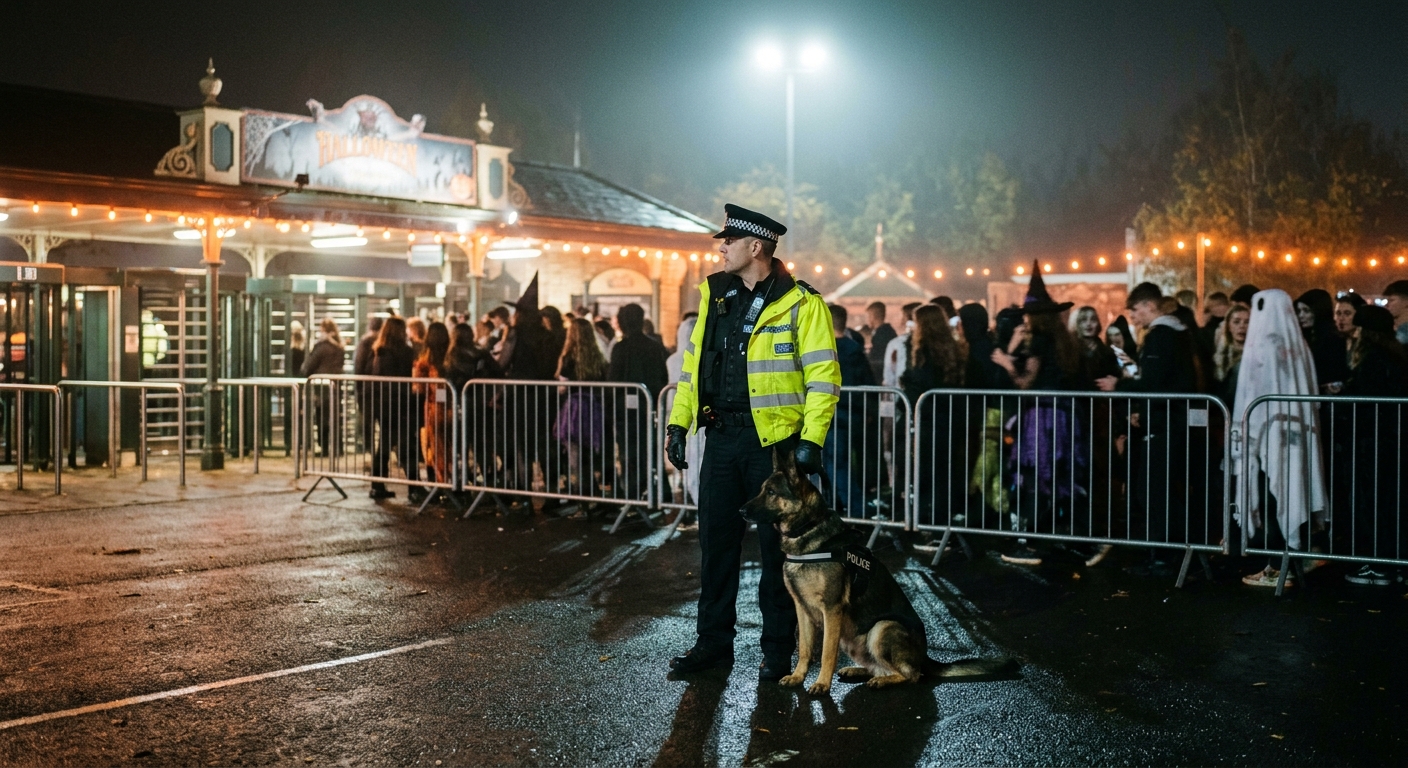
Of those 1,267 searches, 1,063 — 84% — found nothing. There were 9 arrests.
243 of the people searched were children aged 10 to 17, which will surprise nobody who knows the target audience of a Halloween scare maze. Twelve hundred teenagers and twenty-somethings lined up at a theme park to be sniffed by a dog, and five in six were clean.
The rest of the top ten is railway stations — New Street, London Bridge, Piccadilly, Euston, Stratford, Leeds — plus Brighton seafront, two points in Liverpool city centre and one in Brixton.
That’s the British Transport Police’s dog teams and the forces that put officers where the crowds are. It is, once again, searching where the people are rather than where the drugs are.
Who gets searched
This part everyone already knows, and the data confirms it as flatly as ever. In London, 40% of drug searches are of Black people and 38% of White people, in a city that is about 13% Black.
The “find” rates are almost identical — 65% of searches of Black Londoners find nothing, 67% of White. The officers aren’t better at finding drugs on Black people. They just search more of them.
The cannabis warning is dead
One small thing that jumped out. Fifteen years ago, if you were caught with a bit of weed, the standard outcome was a cannabis warning — a street disposal, no record beyond the police’s own.
In three years of data there are 3,447 of them, and the share falls every year: 0.7% of drug searches in 2023, 0.3% in 2026.
They’ve been replaced by the “community resolution,” which has climbed from 11% to 14%. Different name, similar thing, but it lives on a database and it can show up on an enhanced DBS check. The most lenient end of the system has quietly got a little less lenient.
What this does and doesn’t show
I can’t tell you from this data that a single one of these searches was unlawful. Every one of them will have a recorded ground, and “smelled of cannabis” is still accepted in most forces despite the College of Policing saying it shouldn’t be enough on its own.
What I can tell you is what the aggregate looks like, and the aggregate is a policing model built on the assumption that the way to deal with the country’s most-used illegal drug is to search as many people as possible and hope.
Eight hundred thousand searches. Five hundred and fifty thousand of them for nothing. Twenty thousand where someone was made to undress. Eighty thousand children. A theme park. Every one of those searches is a person who now trusts the police a bit less than they did that morning, and in two-thirds of cases they hadn’t even done the thing they were suspected of.
In the Canada piece I showed that when cannabis gets a label, the spice moves out of the weed and into the fentanyl. This is the other side of the same ledger. In a country where cannabis is legal, this entire apparatus — the dogs at the theme park, the four o’clock school-gate searches, the strip searches of children — simply has nothing to do. In Britain it’s half of what stop-and-search is for.
Nobody is going to change the Misuse of Drugs Act because of a chart on a blog.
But the next time a Chief Constable stands up and says stop-and-search is about taking knives off the street, you can show them that it’s mostly about weed, that it mostly finds nothing, and that its single busiest location is the queue for a rollercoaster.
Method and data
- Source: the stop-and-search records published under the Open Government Licence at data.police.uk, August 2023 to July 2026 inclusive, all forces that supply data. That’s 1,456,741 searches, of which 811,792 recorded “controlled drugs” as the object of search. Greater Manchester, Essex, Gwent and Hampshire don’t publish to the site, so this covers 40 forces, not 44. Several forces have gaps of a few months; per-capita rates are annualised from the months available.
- “Found nothing” means the recorded outcome was “a no further action disposal.” The data also has a field for whether the outcome was linked to the object of search, but forces record it so inconsistently (the Met logs every one as “no”, Thames Valley every one as “yes”) that it’s unusable; I’ve ignored it.
- Per-capita rates use ONS mid-year population estimates for each force area, last twelve months of data only. British Transport Police and City of London have no resident population to divide by and are left out of that chart.
- Times are UK local time. Cleveland records every search at 00:00 and is excluded from the hour-of-day chart.
- Locations are anonymised by data.police.uk: each search is snapped to the nearest point on a fixed list of public locations, so a pin marks the area served by that point, not where anyone stood. Thorpe Park sits on an island surrounded by lakes, which is why its pin is so clean. The station and city-centre points cover the streets around them.
- Ethnicity is officer-defined, and London’s population share is from the 2021 Census.
- No individual record is reproduced, and nothing here identifies any person searched. The spreadsheet is available to anyone who asks.
